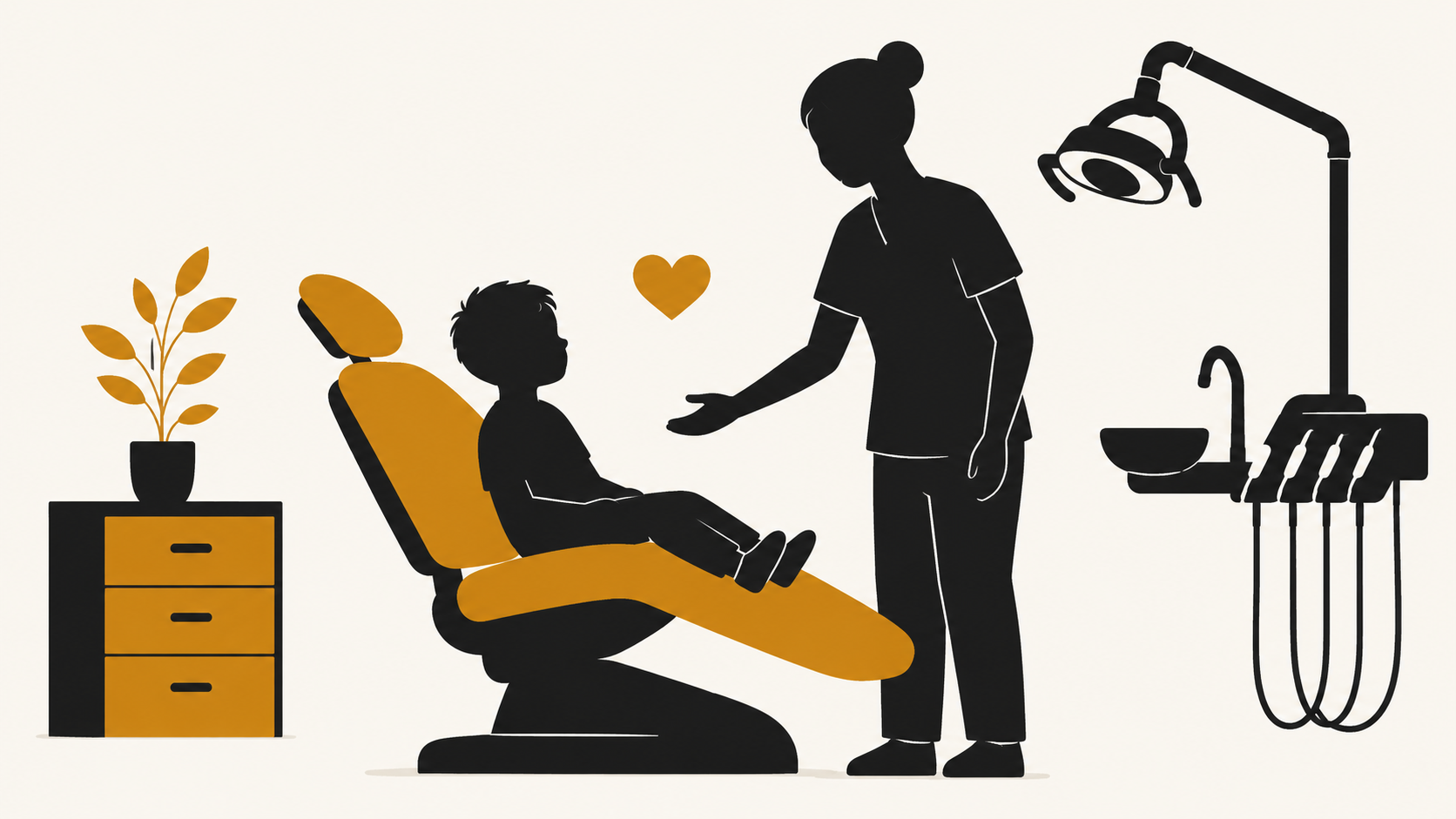
Dental anxiety is not a character flaw, and it is not something kids need to "get over." It is a normal response to an unfamiliar room, bright lights, strange sounds, and a person they just met asking to put metal tools in their mouth. The good news is that childhood is also when a positive dental experience cements for life — get the first few visits right and you raise a kid who treats dental appointments as a non-event.
Here is what works, distilled from pediatric dentists who have spent decades getting nervous kids to open wide.
Start with how you talk about it
Kids pick up nervousness from parents long before they pick it up from waiting rooms. A few language swaps make a real difference:
- Skip "it won't hurt." The brain hears "hurt" and assumes there is a reason you brought it up. Try "the dentist is going to count your teeth" instead.
- Avoid words like shot, drill, pull, pain, scary, and bad. Pediatric dentists use a softer vocabulary on purpose — sleepy juice instead of shot, Mr. Whistle instead of drill, wiggling out a tooth instead of pulling.
- Do not tell stories about your own bad dental experiences. Save those for your group chat. To a four-year-old, a parent's story is prophecy.
- If a sibling has had a hard visit, do not let them be the one who briefs the younger kid.
A simple script: "Tomorrow we're going to the dentist. They're going to look at your teeth, count them, and clean them with a special tickly toothbrush. I'll be right there. Then we'll get a sticker."
Pick a true pediatric dentist for the first few visits
A pediatric dentist (sometimes called a pedodontist) does an extra two to three years of training specifically on children. Their offices are built for this — smaller chairs, ceiling TVs, prize boxes, gentle staff who can read a kid's body language in seconds. General dentists who say they "love kids" can be wonderful, but the office environment alone makes a difference for an anxious child.
Look for these signs:
- The waiting room has toys, books, or a small play area
- Treatment rooms have screens or toys above the chair
- The team uses tell-show-do — they explain a tool, show it on a finger, then use it
- They offer a happy visit — a no-cost intro where the child meets the team without any work being done
- They know how to handle a meltdown without shaming the kid
The American Academy of Pediatric Dentistry recommends a first visit by age one or within six months of the first tooth coming in. The first appointments are short, friendly, and mostly about counting teeth and giving Mom and Dad guidance.
Practice the visit at home
Role-play is genuinely effective for anxious kids. Make it goofy. You sit in a kitchen chair, kid plays dentist, counts your teeth with a popsicle stick, "polishes" with a dry toothbrush. Then you swap. Throw in a stuffed animal patient too — it gives the kid a way to project their nerves onto a third party and watch them get treated kindly.
Children's books are surprisingly helpful here. Stock favorites like The Berenstain Bears Visit the Dentist, Just Going to the Dentist by Mercer Mayer, and Dentist Trip (Peppa Pig). Read one a few nights before the appointment, not the morning of.
At the appointment
A few moves that consistently help:
- Schedule the appointment for the kid's best time of day. A two-year-old at 4 p.m. is rarely the same kid as a two-year-old at 10 a.m.
- Skip the candy reward and pick something neutral — a sticker, a bubble wand, a trip to the playground after.
- Let the dentist lead. Hovering parents tend to interrupt the rapport that pediatric dentists are trained to build in the first 90 seconds.
- If your child needs to sit on your lap during the exam, ask. Most pediatric offices allow it for the first visit or two.
- Praise effort, not bravery. "You did such a good job opening wide when she asked" lands better than "You were so brave."
When anxiety is bigger than the room
Some kids — especially those with sensory differences, past medical trauma, or specific phobias — need more than a friendly office. Options that exist and work:
- Nitrous oxide (laughing gas) for short procedures. Wears off quickly, no aftermath.
- Oral conscious sedation for longer or more invasive work. Kid is awake but very relaxed.
- General anesthesia for extensive work, usually done in a hospital or surgical center.
A pediatric dentist will not jump to sedation for a routine cleaning. If they are recommending it, ask why, what the alternative would look like, and what happens if you wait six months and try again with a different approach.
The goal in early childhood is not perfect cooperation. It is building a child who, by age 10, walks into a dental office without dread. That foundation pays off for the next 70 years.
Take the next step
Find your match for this
Take the quick personality quiz and let AI matching surface practices that fit your situation, predicted from verified signals like insurance, location, and what you want to fix.
Go deeper on this topic
Costs, treatment options, and specialists related to this guide, with AI matching built in.
Pediatric Dentistry
Dentists trained to actually be good with kids.
SpecialistsPediatric Dentists
Pediatric dentists specialize in dental care for infants, children, teens, and patients with special needs.
SpecialistsGeneral Dentists
General dentists handle preventive care, cleanings, fillings, and routine oral health for the whole family.
ResearchU.S. Dental Access Report 2026
State-by-state data on where dental care is easy to reach, and where it isn't.
frequently asked questions
- What should I say to my child before a dental visit?
- Keep it concrete and neutral: the dentist is going to count your teeth and clean them, and you will be right there. Skip "it won't hurt", because the brain hears "hurt" and assumes there was a reason to bring it up.
- When should a child first see a dentist?
- The American Academy of Pediatric Dentistry recommends a first visit by age one, or within six months of the first tooth coming in. Those early appointments are short and mostly about counting teeth and coaching the parents.
- Is a pediatric dentist worth it for an anxious child?
- For the first few visits, usually yes. A pediatric dentist trains an extra two to three years on children, and the office itself is built for them: smaller chairs, screens above the chair, and a tell-show-do routine instead of surprising a kid with a tool.
- What if my child is too anxious to cooperate at all?
- Nitrous oxide covers short procedures, oral conscious sedation covers longer work, and general anesthesia covers extensive treatment. A pediatric dentist should not jump to sedation for a routine cleaning, so ask why it is being recommended and what waiting six months would look like.
Keep exploring
More guides to help you find the right practice fit.
When Your Kid Is Scared of the Dentist: A Parent's Playbook
6 min read
PreventionDental Sealants: Who They Help and When to Ask
6 min read
AnxietyHow to Find a Dentist You're Not Scared Of: Starting from Fear
6 min read
General HealthSleep Apnea and Dentistry: How Your Dentist Can Help You Breathe Better
6 min read