Twenty years ago this question barely existed. If you needed your teeth straightened, you got metal braces. Today there are clear aligner systems from a dozen brands, ceramic braces, lingual (behind-the-teeth) braces, and a mountain of social media confidence about which one is best. The honest answer is that the right pick depends on what you are correcting, what your daily life looks like, and what you can comfortably budget.
What each system actually does
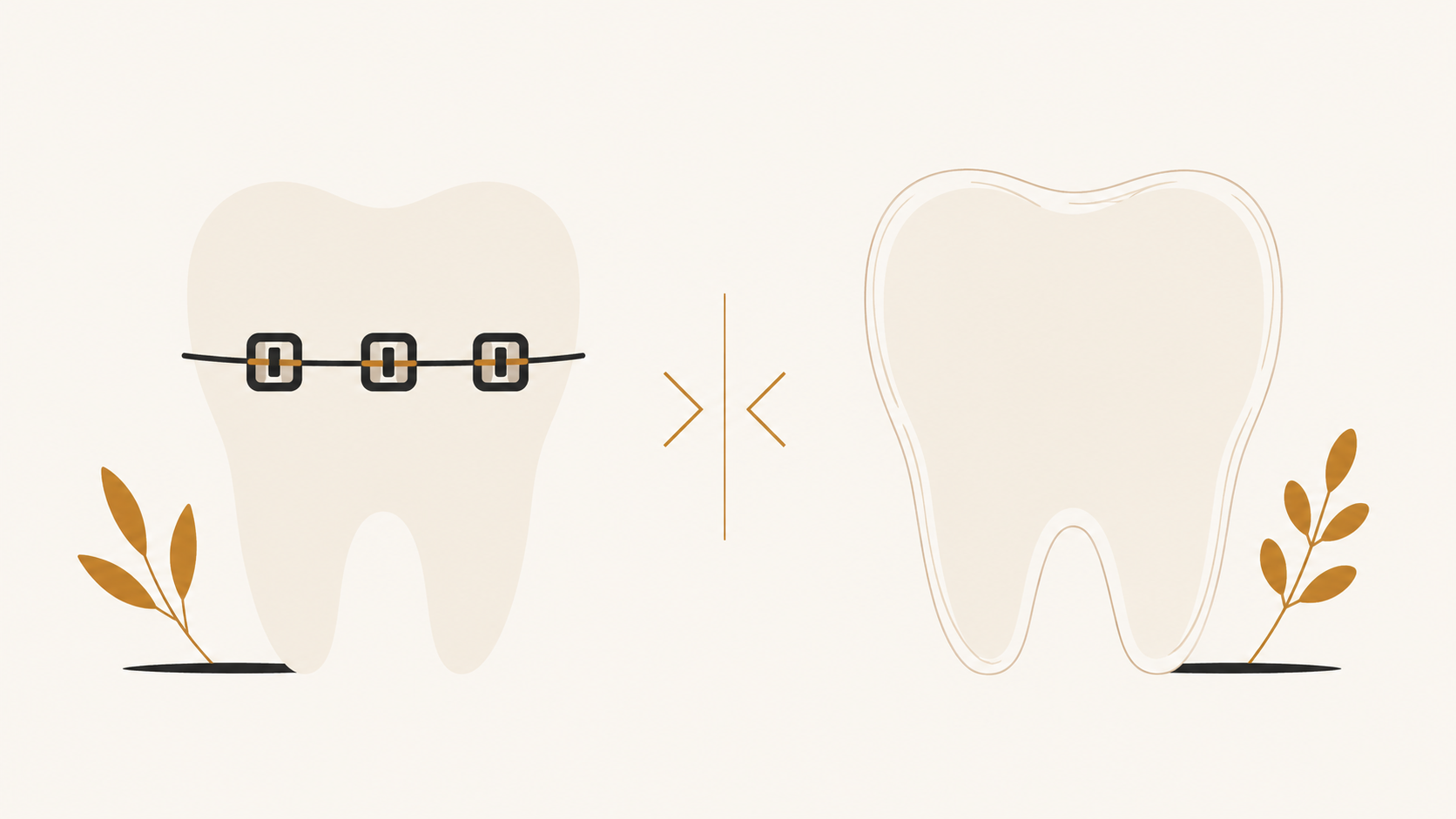
Traditional metal braces bond brackets to each tooth and run a thin wire through them. The orthodontist tightens or swaps the wire every four to six weeks, gradually moving teeth into position. Modern braces are smaller, smoother, and a fraction of the size they were in the 1990s.
Invisalign and other clear aligners use a series of removable plastic trays. Each tray nudges your teeth a fraction of a millimeter, and you swap to the next tray every one to two weeks. A typical case uses 20 to 50 trays. Small tooth-colored "attachments" are bonded to some teeth so the trays can grip and move them.
Both systems apply the same physics — gentle, sustained pressure that remodels the bone around the tooth root. The difference is how that pressure is delivered.
What each can fix
For most common cases, the two are interchangeable. Invisalign has gotten dramatically better at handling crowding, spacing, mild-to-moderate bite issues, and rotation. Braces still have an edge for:
- Severe rotations of canines and premolars
- Significant bite problems that need elastics for many months
- Cases where teeth need to be moved vertically (intrusion or extrusion)
- Younger patients whose jaw growth needs to be guided alongside tooth movement
If you have a complicated case, an orthodontist will tell you straight up. Be wary of any provider who insists clear aligners can fix everything — at-home aligner companies have spent a lot of marketing money on that idea and the malpractice cases tell a different story.
Cost comparison
Pricing varies wildly by city, complexity, and provider, but useful 2026 ranges look like this:
- Metal braces: $3,000 to $7,000 for a full case
- Ceramic braces: $4,000 to $8,000
- Invisalign (in-office): $4,000 to $8,000
- Lingual braces: $8,000 to $13,000
- Mail-order aligners: $1,500 to $2,500 (with significant caveats)
Most orthodontists charge a single comprehensive fee that covers all visits, adjustments, and the first set of retainers. Insurance with orthodontic coverage usually pays a lifetime maximum of $1,500 to $2,500 toward either system. HSA and FSA dollars work for both.
Mail-order aligners are cheaper because nobody examines your mouth, takes 3D scans in person, or supervises the movement. The cases that go wrong go very wrong — and those teeth often end up in a real orthodontist's office for double the original cost.
Lifestyle trade-offs
This is the part that decides most cases.
Eating. Aligners come out for every meal and every drink other than water. That means 22 hours a day of compliance and the discipline to brush before each tray goes back in. Braces stay in. You eat around them, which means avoiding popcorn, hard candy, gum, and corn on the cob for the duration.
Cleaning. Aligners win here. You floss like normal because nothing is bonded to your teeth. Braces require a water flosser or threader and add 5 to 10 minutes to your daily routine.
Appearance. Aligners are not invisible — the attachments are visible up close — but they are far less obvious than braces. Ceramic braces split the difference but cost more and stain more easily.
Visits. Braces typically require an in-person check every six weeks. Invisalign visits run every 8 to 12 weeks once you are tray-cycling smoothly. If your orthodontist offers virtual check-ins between visits, you might only see them in person three or four times a year.
Compliance. Braces work whether you cooperate or not. Aligners only work if you wear them 22 hours a day, every day. Take a long weekend off and you may need to back up two trays. If you know yourself, choose accordingly.
Treatment time
For comparable cases, both systems finish in roughly the same window — usually 12 to 24 months for a full correction, sometimes 6 to 9 months for a minor case. The "Invisalign is faster" claim is mostly marketing. What does change the timeline is the complexity of the case and how well you wear elastics or aligners.
How to decide
Get a consultation with a board-certified orthodontist who offers both systems. The bias matters — a practice that only does one will recommend the one they do. Ask them which one they would recommend for your specific case and why. A good orthodontist will tell you when one option is genuinely better, and when it is a coin flip.
Whichever you choose, the most important step happens after treatment ends: wearing your retainers. Teeth want to drift back to where they started. The retainer is the difference between a smile that stays straight for 30 years and one that shifts in three.
Take the next step
Find your match for this
Take the quick personality quiz and let AI matching surface practices that fit your situation, predicted from verified signals like insurance, location, and what you want to fix.
Go deeper on this topic
Costs, treatment options, and specialists related to this guide, with AI matching built in.
Invisalign cost guide
What invisalign costs nationally, and what moves the price.
Cost guideBraces cost guide
What braces costs nationally, and what moves the price.
TreatmentOrthodontics
Braces, clear aligners, and bite correction for kids and adults.
SpecialistsOrthodontists
Orthodontists straighten teeth and correct bite issues using braces, Invisalign, and other appliances.
frequently asked questions
- Is Invisalign faster than braces?
- Usually not. Comparable cases finish in about the same window, roughly 12 to 24 months for a full correction. Case complexity and how reliably you wear aligners or elastics move the timeline far more than the system you pick does.
- What do braces and Invisalign cost?
- In 2026, metal braces run $3,000 to $7,000, ceramic braces $4,000 to $8,000, in-office Invisalign $4,000 to $8,000, and lingual braces $8,000 to $13,000. Orthodontic coverage typically pays a lifetime maximum of $1,500 to $2,500 toward either, and HSA or FSA dollars work for both.
- When are braces still the better choice?
- For severe rotations of canines and premolars, bite problems that need elastics for many months, cases where teeth have to move vertically, and younger patients whose jaw growth has to be guided alongside the tooth movement.
- Are mail-order aligners a reasonable way to save money?
- They cost $1,500 to $2,500 because nobody examines your mouth in person, scans it, or supervises the movement. The cases that go wrong tend to go badly wrong, and fixing them with a real orthodontist often costs more than the original treatment would have.
Keep exploring
More guides to help you find the right practice fit.
How to Tell If a Practice Is Actually Good at Cosmetic Work
7 min read
CosmeticDoes Teeth Whitening Actually Work? The Science, the Limits, and What to Expect
6 min read
CosmeticVeneers vs Bonding: Which Is Right for Your Smile?
6 min read
CosmeticTeeth Whitening Options: Which Method Fits Your Situation
5 min read